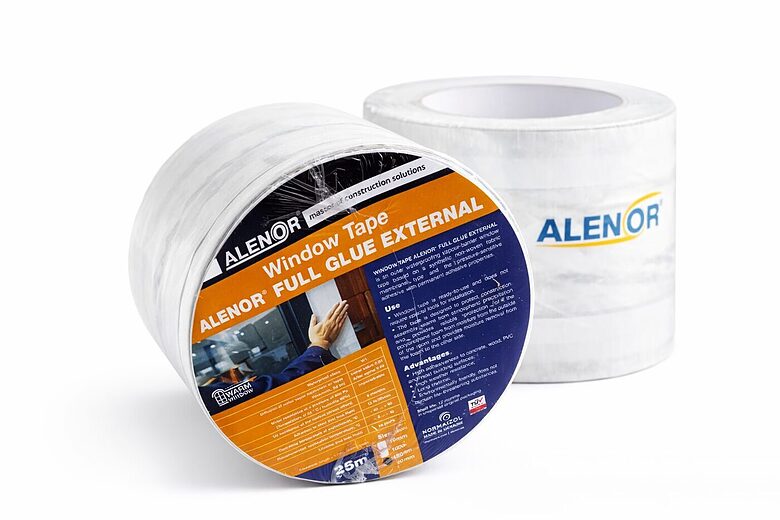


Alenor internal window sealing tape with full-surface adhesive
Alenor internal window tape is a vapour-barrier tape applied on the inside of the installation joint – the room side. It stops indoor moisture from getting into the installation foam, so the foam stays dry and keeps its insulating properties. The adhesive covers the full width of the tape, so it bonds to the whole surface without air pockets, even on an uneven reveal.
The tape is based on a membrane-type synthetic non-woven fabric with a foil coating and a pressure-sensitive adhesive with permanent tack and high adhesion and cohesion. The adhesive layer is covered with a release film. The tape is ready to use and needs no special tools.
Technical data
- Sizes: 70 mm × 25 m, 100 mm × 25 m, 150 mm × 25 m
- Colour: white
- Vapour diffusion-equivalent air layer thickness Sd: over 1500 m – vapour barrier
- Watertight at 600 Pa
- Composition: foil-coated non-woven fabric, pressure-sensitive adhesive, release film
- Adhesive: full tape width
- Surfaces: concrete, brick, timber, PVC and most building materials
- Service temperature: −40 °C to +90 °C
- Application temperature: +5 °C to +40 °C
- UV resistance of the fabric in direct sun: 3 months
- Service life: at least 10 years
- Shelf life in original packaging: 12 months
- Suitable for passive houses
Where to use it
- Installing PVC, timber and aluminium windows – on the inside of the joint between frame and wall opening.
- Balcony doors and balcony units.
- Joints of curtain walls and large glazed structures with the wall.
- Window replacement in renovated buildings with uneven reveals.
- Passive and low-energy houses where an airtight joint is required.
How to apply
- Clean the reveal of dust, grease and old mortar. The surface must be dry.
- Prime porous surfaces (concrete, brick, aerated concrete) with Alenor Super-Fix primer first – otherwise the tape may come off.
- Stick the tape to the inner edge of the window frame before placing the window in the opening.
- Once the foam has cured and been trimmed, remove the release film and stick the tape to the reveal.
- Press the tape firmly along its whole length with a pressure roller, especially in corners.
Internal or external window tape?
The internal tape is a vapour barrier – it stops moisture from the room side. The external window tape is vapour-permeable: it protects the joint from rain and wind but lets moisture dry outwards. Correct window installation needs both – tighter inside, more open outside. In numbers: the internal tape has Sd over 1500 m, the external one 0.81 m, so moisture can always leave the joint and does not build up in the foam.
Frequently asked questions
Why does the vapour-barrier tape go on the inside?
In winter, indoor air is warmer and more humid than outdoor air, so water vapour moves from inside to outside. The internal tape stops it before the foam. If the barrier were outside, moisture would be trapped in the foam and it would lose its insulating ability.
Can the tape be applied in winter?
The recommended application temperature is above +5 °C. In colder conditions the adhesive does not bond fully. If you have to work in winter, warm up both the tape and the surface temporarily.
Which width should I choose?
The tape must cover the joint and leave a secure adhesive strip on both frame and reveal. 70 mm is usually enough for narrow joints; choose 100 or 150 mm for wider joints and uneven reveals.
More on window installation: window tapes guide, how to insulate windows with mounting tapes and why external window tape matters. All window installation tapes are in the window tapes category.
Delivery and wholesale
We deliver to DPD, Omniva and Venipak parcel lockers across Latvia in 2–3 working days and to Lithuania and Estonia in 2–5 working days (delivery terms). Construction companies and resellers get wholesale prices – email [email protected] or call +371 28348301.